
Checking Criminal History in Tuscola County
Start with the record that can answer the question. MiCOURT is the first stop for a public Tuscola County case, while the Sheriff or a city police department keeps its own incident report. The jail can confirm current county custody by phone. ICHAT provides a statewide public repository result, and OTIS covers people within specified Michigan corrections categories. None of those tools is a full copy of the others. A search that checks only one may miss the event, the current status, or the final result. The most useful starting facts are a correct legal name, likely spelling variants, date of birth when the system accepts it, the event date, and the agency or court involved. Then work from the narrow local source toward the broader state source:
- Search both participating Tuscola County courts in MiCOURT for filed criminal cases.
- Match the name, court, case number, filing date, and charge details before treating a result as the right person.
- Call the Sheriff/Jail when the question is current county custody, since no verified official web roster was found.
- Request the incident or arrest report from the agency that created it, not from a different police office.
- Use ICHAT for public Michigan repository history and order clerk copies when the filed court document itself is needed.
In practical terms, the chain is Incident or Arrest Report → Jail Booking → Prosecutor Charge → Court Disposition → State Repository Update. Each stage has its own custodian. A lag or gap at one stage does not prove that no other record exists.
The official Tuscola County directory shows the county offices that anchor this record trail.
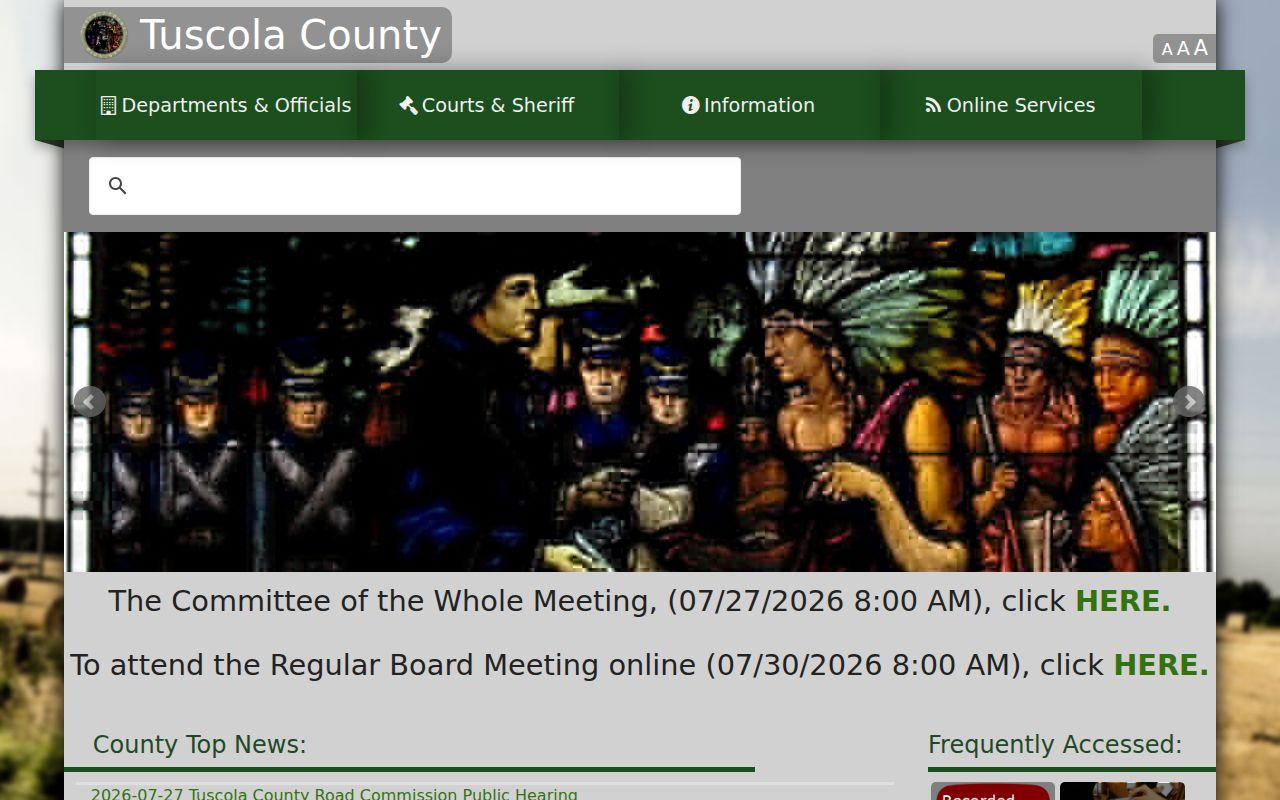
That directory is best used to reach the custodian, while the court, sheriff, or state system supplies the record itself.
Two Caro Counters Split Tuscola County Records
Tuscola County criminal records are concentrated in Caro, yet they are not kept at one counter. The courthouse at 440 N. State Street holds the 71B District Court, 54th Circuit Court, and clerk functions. The Sheriff’s Office and Jail at 420 Court Street hold sheriff-created reports, booking material, and current custody information. The buildings are close. Their legal roles remain distinct.
A felony illustrates the split. Its first court stage takes place in District Court, and a bindover sends it to Circuit Court. The jail record still documents intake and custody, while the police report stays with the arresting agency. Ordering a register of actions from the clerk does not produce the narrative incident report. Asking the Sheriff for a court pleading does not make that office the custodian. Identify the record first, then contact the right office.
The Tuscola County Sheriff’s official page displays the sheriff and jail channel used for agency records and custody questions.
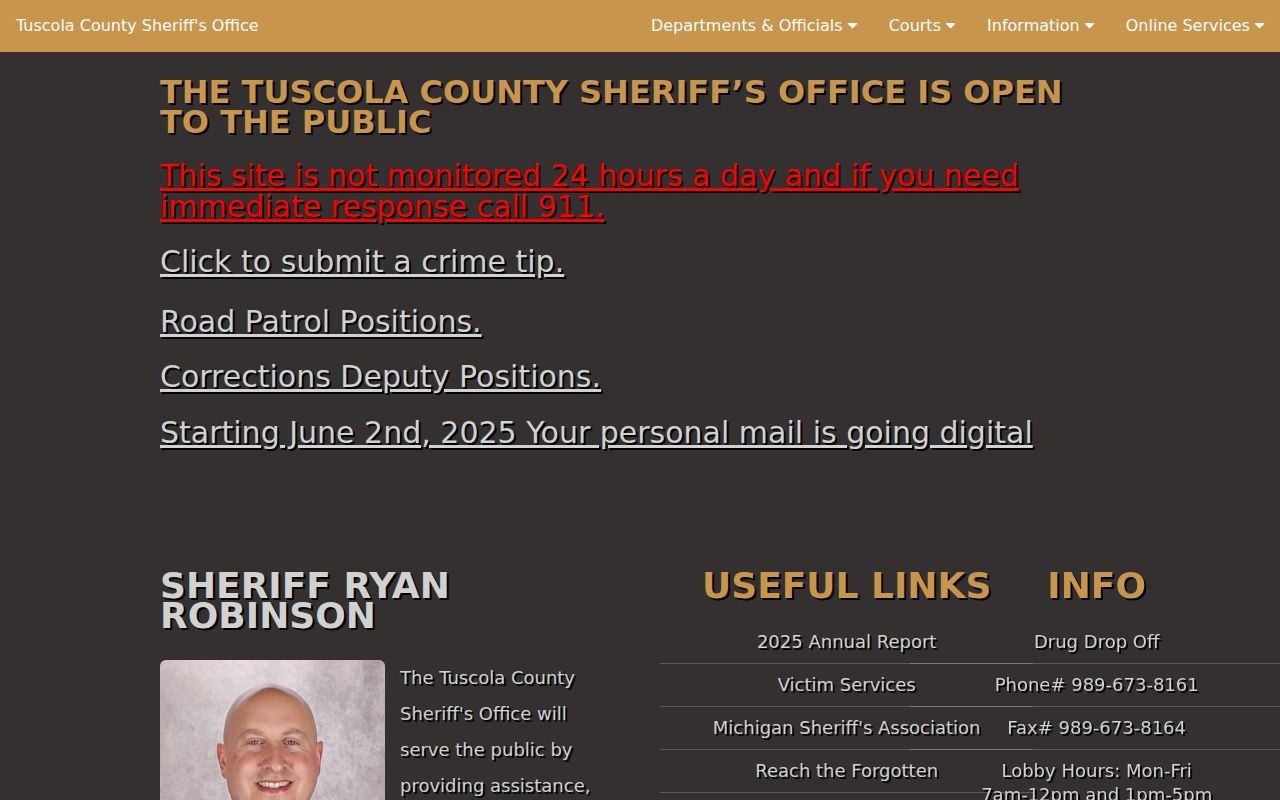
The sheriff channel complements the courthouse record trail; it does not combine those files into one county criminal history.
Michigan Official Background Checks
Michigan State Police Criminal Justice Information Center is the state central repository. Its public name-based service, ICHAT, costs $10 per search. A search requires first name, last name, date of birth, sex, and race; middle names or aliases can improve the match. The public result includes Michigan felony arrests and felony and reportable-misdemeanor convictions sent to the repository. It excludes warrants, suppressed records, traffic matters, juvenile records, federal, tribal, out-of-state, and local misdemeanors that are not reportable.
A person who wants a more complete review of their own Michigan record can use fingerprints. MSP accepts the RI-008 Michigan Applicant Fingerprint Card, or an FD-258 card from outside Michigan, with a $30 personal-record fee. Michigan-authorized Live Scan vendors and some law-enforcement agencies capture fingerprints, but service, appointments, and local fees vary. Call before travel. A separate FBI Identity History Summary costs $18 and is requested by the person whose record is reviewed. It is not a Tuscola County case file.
| Official product | Fee | What it answers |
|---|---|---|
| ICHAT | $10 per search | Public Michigan repository information |
| MSP fingerprint record review | $30 | The requester’s Michigan public and nonpublic record tied to fingerprints |
| FBI Identity History Summary | $18 | The requester’s FBI-maintained identity history |
| Tuscola clerk name search | $5 per name from 1989 forward | Local Circuit file search, with added older-year fees |
| MSP set-aside processing | $50 | Agency processing for an application set-aside packet |
MiCOURT Search for Tuscola County Records
Tuscola County participates in MiCOURT Case Search through both 71B District Court and 54th Circuit Court. District Court handles misdemeanors and the early stages of a felony. Circuit Court handles a felony after bindover. A searcher should check both courts when a felony may have crossed that line. The statewide court selector and direct court routes offer name and case-number searches, subject to the fields shown for that court.
The official MiCOURT Case Search uses these core fields for Tuscola County criminal case records:
| Field | Use | Search note |
|---|---|---|
| Court | Choose 71B District or 54th Circuit | Check both for a felony route |
| Search Type | Name or Case Number | Use the case number when known |
| Last Name / Business Name | Core name field | Legal spelling matters |
| First and Middle Name | Narrows the result | Middle name may be optional |
| Date of Birth | Helps distinguish people | Availability can vary |
| Case Number | Direct case search | Follow the displayed format |
A public result may show the court, case number, filing date, status, charges, events, dispositions, scheduled hearings, and public financial entries. It may not contain downloadable pleadings or exhibits. Some participating courts also apply a seven-year criminal sentence filter. A blank result is therefore not proof that no record exists. The clerk’s register of actions and file remain the official fallback. The Tuscola County Courts page places both trial courts in their local setting.
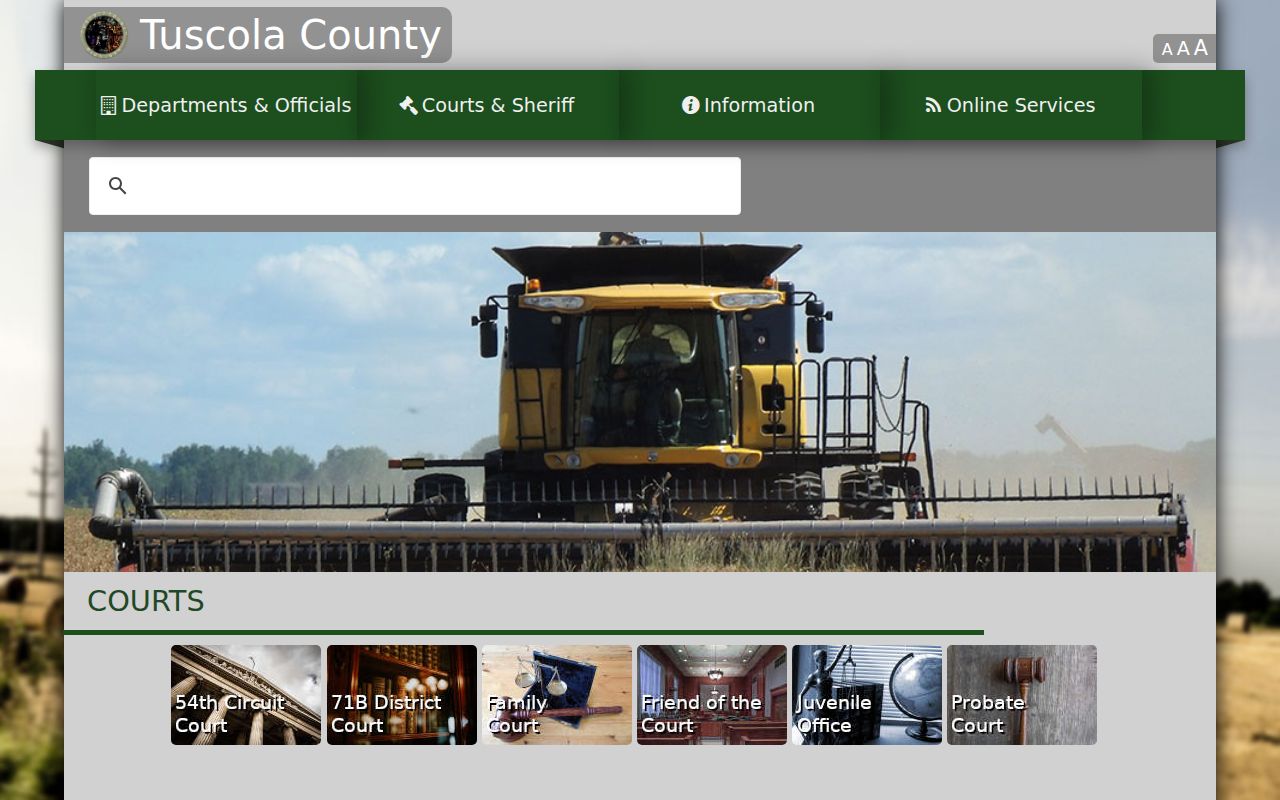
The county court page helps route a search when MiCOURT identifies the court but an actual filed paper or clerk answer is still needed.
Criminal Record Types
A criminal history is not one document. Tuscola County agencies create records at different points, and the prosecutor, courts, jail, and state repository may describe the same event in different terms. The event date and case number help connect them, but the charge as booked may later be changed, declined, dismissed, or resolved under another count.
- Incident or arrest report: the responding agency’s account of an allegation, actions, and evidence references.
- Booking record: the jail intake record, including custody, bond, holds, and release data that may change fast.
- Court case file: the register of actions, filed charges, motions, orders, plea or trial result, and sentence.
- Repository history: CJIC’s fingerprint and identity-linked summary of reportable Michigan events.
- Warrant, supervision, and registry records: separate systems that answer narrower questions and carry their own access limits.
The state’s public criminal-history scope is described on the MSP Criminal History Records page.
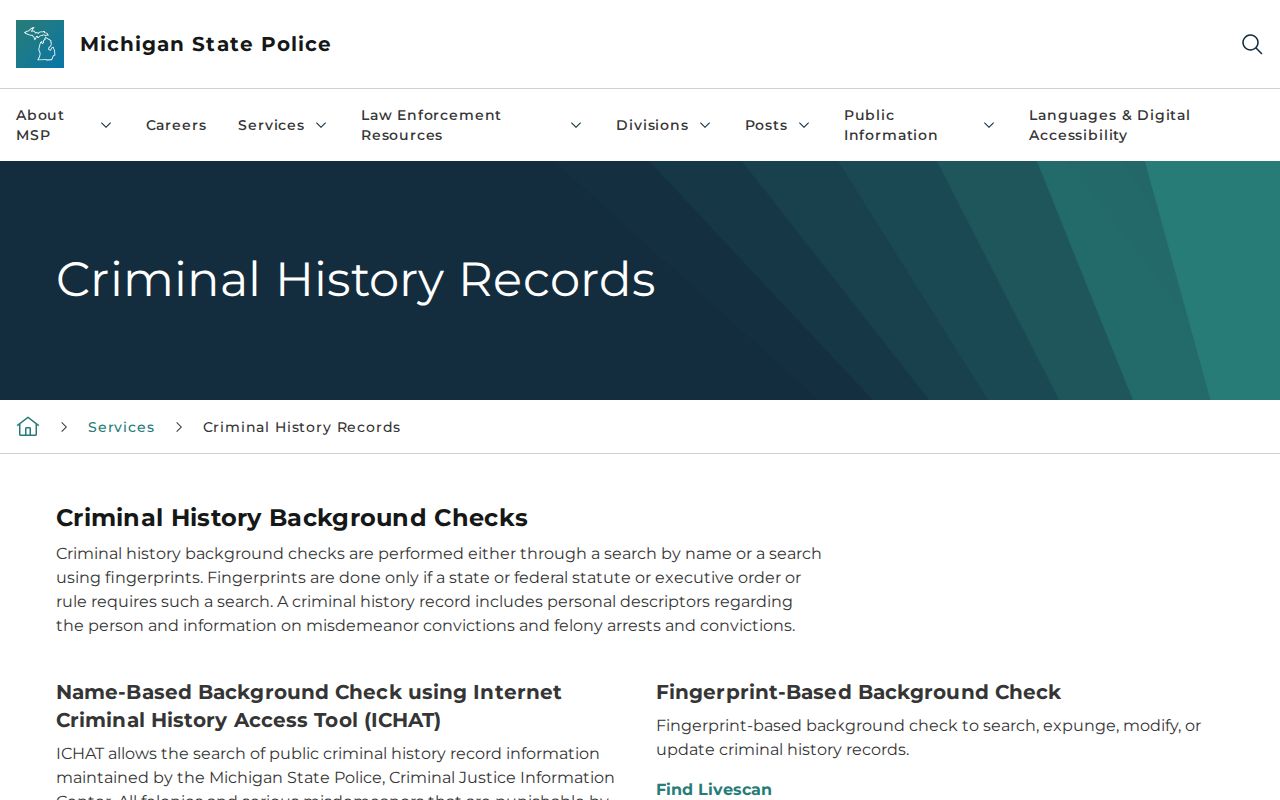
The MSP material explains why a local Tuscola County court record may exist even when the public repository result does not show it.
ICHAT Limits on Tuscola County Records
ICHAT is statewide, but it is not a full local case file. That distinction trips up many searches. A Tuscola County misdemeanor may appear in MiCOURT yet fall outside the public repository’s reportable categories. A warrant will not appear in ICHAT at all. In the other direction, ICHAT can show a reportable Michigan event from another county that is absent from a Tuscola-only court search.
Use the portal’s result as a repository summary. Check its identity match, arrest cycle, charges, and disposition data. Then return to the court of conviction for the register of actions, complaint or information, and final orders. If an event appears wrong or lacks a disposition, a fingerprint-based personal review is the better path to identify whether the mismatch is tied to an alias, reporting lag, or state identification record. The court that entered a result and MSP’s record update process address different parts of a correction.
Note: ICHAT excludes warrants, so a clear public name search never settles whether a Tuscola County bench or arrest warrant exists.
Inside a Tuscola County Criminal Record
The fields depend on the source. A booking record captures intake at one point. A court file follows the case through adjudication. A repository record links reportable events to identity and fingerprint data. Read the field label before drawing a conclusion, and use the final disposition for each count instead of treating the first charge as the outcome.
| Name and Identifiers | Legal name, aliases, date of birth, physical descriptors, and a state identifier where the system publishes it. |
|---|---|
| Arrest / Booking Data | Agency, intake date, booked charge, bond or hold, custody status, and release information when releasable. |
| Charges and Statutes | Count, offense description, code citation, classification, and the charge actually filed by the prosecutor. |
| Disposition | Conviction, dismissal, acquittal, or another count-by-count result entered by the court. |
| Sentence | Custody, probation, financial assessments, and other public terms shown in the register of actions or order. |
| Supervision Status | Probation, prison, parole, or discharge information within the scope and date limits of the source. |
Tuscola County court terms have precise roles:
- Register of actions
- The clerk’s dated list of filings and court events, useful as the file’s roadmap.
- Probable-cause conference
- A Michigan felony conference in District Court before the preliminary examination.
- Bindover
- The transfer of a felony from 71B District Court to 54th Circuit Court.
- Disposition
- The outcome of an individual count, such as conviction, dismissal, or acquittal.
- Set aside
- Michigan’s process that makes an eligible conviction nonpublic while allowing statutory retention and access.
Tuscola County Booking to Court Records
A Tuscola County arrest starts a chain, not a final finding. The arresting agency writes the report. Jail intake creates a booking file and sends fingerprints for a reportable offense. The prosecutor decides what charge to authorize. A felony begins in 71B District Court and can move to 54th Circuit Court after a preliminary examination or waiver. The courts and prosecutor then report eligible charge and disposition data to CJIC.
This flow explains why labels change. An officer’s suspected offense, the jail’s booked charge, the prosecutor’s complaint, and the final disposition may not match. A dismissal ends the count in court, but it does not by itself erase every agency or repository record. For any Tuscola County criminal record, compare the booked charge with the filed charge and final count result.
The Tuscola County Prosecuting Attorney page identifies the local office that authorizes charges and appears in the county courts.
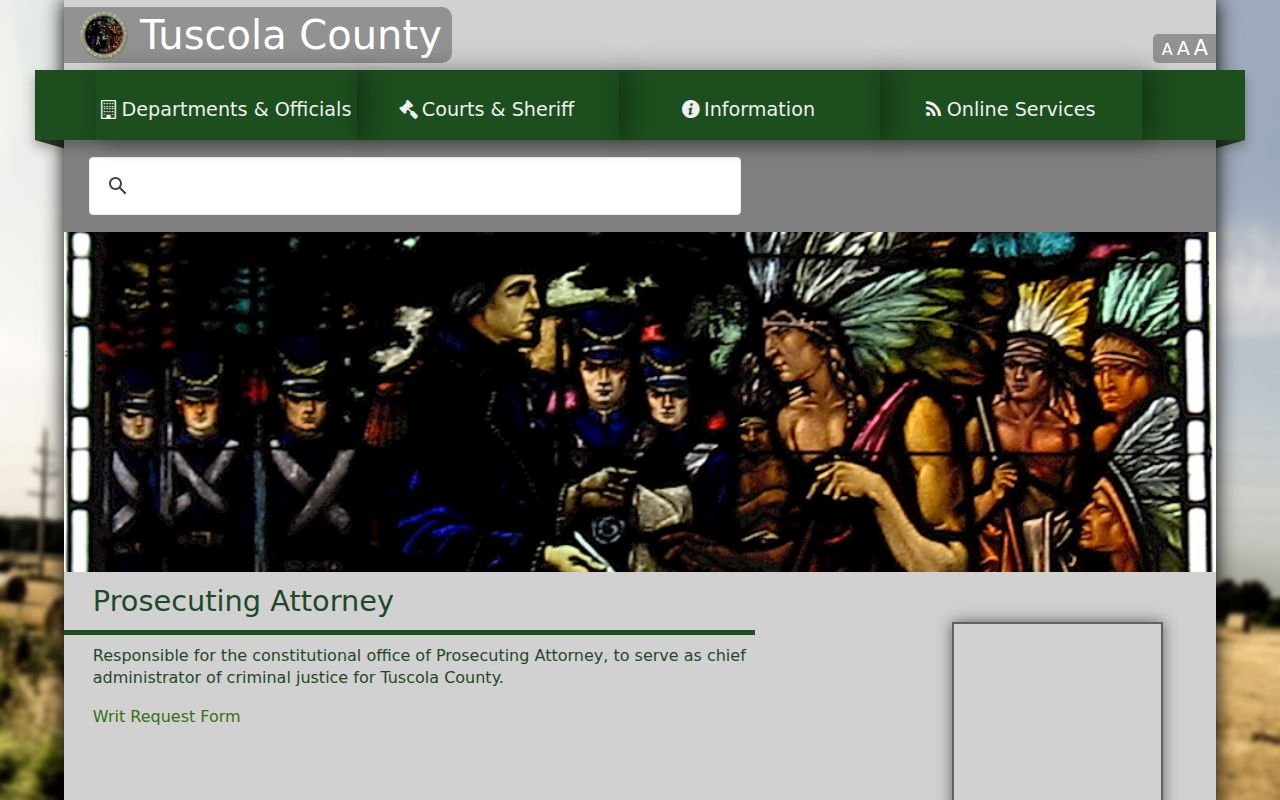
The prosecutor’s role sits between the arrest report and the court disposition, so the initial allegation should never be read as the last word.
Public Access Laws in Michigan
Michigan FOIA applies to releasable records held by public bodies, including sheriff and police agency files. The court’s adjudicative records follow court rules and clerk procedures instead of being treated like an ordinary executive-agency FOIA request. Both routes recognize nonpublic material. Privacy, active-investigation, fair-trial, confidential-source, safety, juvenile, and victim-related limits may lead to redaction or withholding. When feasible, an office should separate exempt material and release the rest.
Key Michigan access rules:
MCL 15.231 states Michigan’s policy favoring access to nonexempt public-body records.
MCL 15.235 sets the ordinary five-business-day response framework and permitted responses or extension notice.
MCL 15.243 lists exemptions, including specified privacy and law-enforcement harms.
MCL 28.243 governs criminal-history dissemination through Michigan’s state system.
MCL 780.621 provides the application-based conviction set-aside framework.
A focused request works best. Name the incident number, date range, location, record type, and preferred electronic return. For a Sheriff-created report, use the Sheriff’s form. For a Caro, Vassar, Cass City, or MSP report, ask the agency that created it.
No Online Tuscola County Jail Records
No verified official public Tuscola County inmate roster or recent-arrest database was located. The proper fallback is direct and clear: call the Sheriff/Jail at 989-673-8161 for current custody routing, search MiCOURT after charges are filed, and submit a focused FOIA request for a releasable Sheriff record. A phone answer can help with present custody, but it is not a certified record. City police reports must still be requested from the city agency.
The current jail at 420 Court Street was designed for 92 people, while county planning material states an operating limit of 87. Custody can change with release, transfer, bond, or court action. That is one reason a static third-party page is a poor substitute for the official phone and court chain. The lack of a person in county custody also does not erase the court case.
OTIS serves another layer. It can show covered MDOC prisoners, parolees, probationers, and some people discharged in the prior three years. It does not function as the routine Tuscola County pretrial jail roster.
Sealed, Expunged, and Restricted Records
Michigan uses both “set aside” and “expungement.” An eligible conviction set aside under MCL 780.621 and related law becomes nonpublic, though the state retains it for uses the law permits. Clean Slate adds automatic set-aside processing for qualifying convictions after statutory periods. It does not clear every offense, and the end of a waiting period does not prove that every public system has been updated.
For an application-based set-aside, review the court file and ICHAT, confirm current eligibility, obtain certified court material and fingerprints, file in the court of conviction, and send the required packet to the prosecutor, Attorney General, and MSP. MSP’s processing packet includes a $50 agency fee and says to allow eight weeks for its record search and mail process. Juvenile matters, suppressed records, victim data, and protected identifiers follow their own access limits.
The MSP conviction set-aside instructions provide the current official packet route.
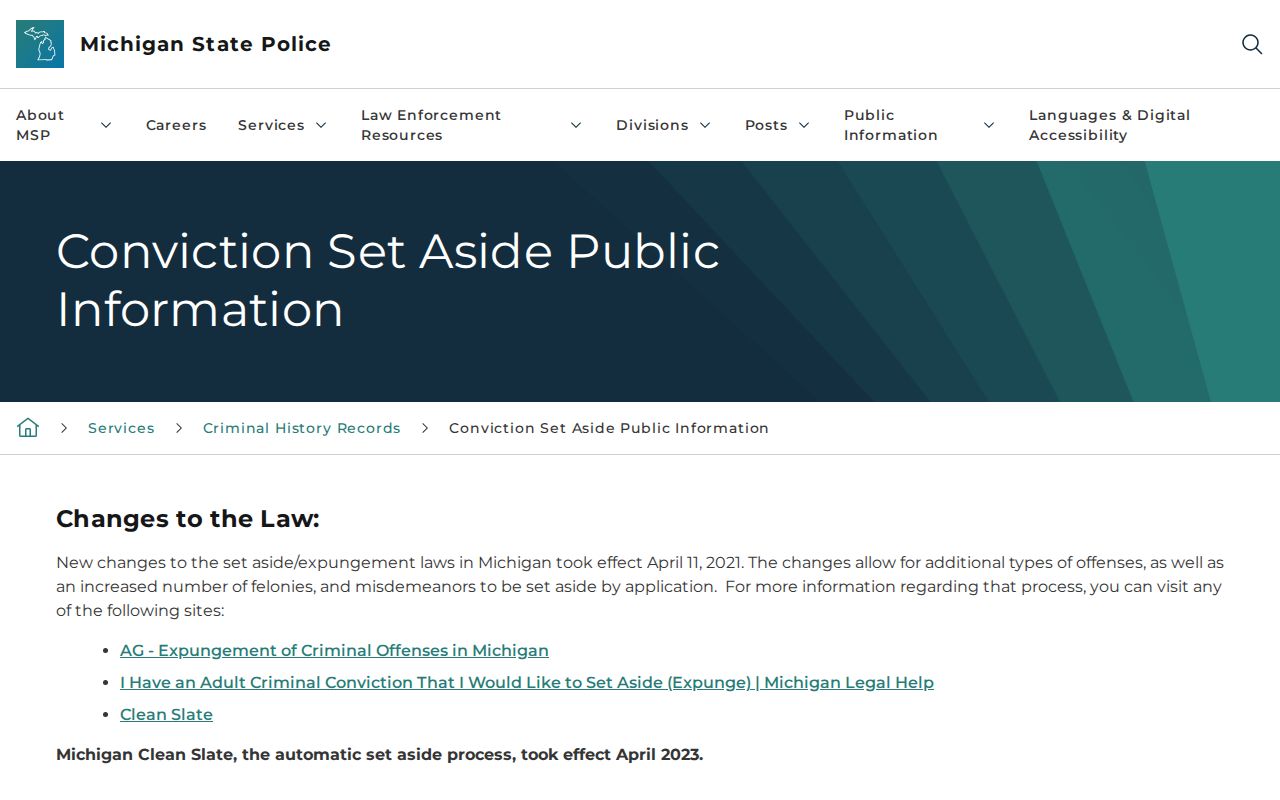
After relief is entered, compare the court of conviction, the $10 ICHAT public view, and a $30 fingerprint personal review when needed to see what remains.
Tuscola County Warrant Record Fallback
No official public Tuscola County warrant search was found, and ICHAT excludes warrants. If a possible warrant concerns your own record, call the court shown on the notice or public case. Use 71B District Court for a misdemeanor or the early felony stage and 54th Circuit Court for a bound-over felony. MiCOURT may show a public event or status, but no result is not proof that no warrant exists.
The Sheriff can route a custody or warrant question at 989-673-8161, and a request may seek releasable warrant information. Sealed or unserved investigative material may be withheld. Do not approach or try to detain anyone. A bench warrant often follows failure to appear or obey a court order, while an arrest warrant rests on a charge and probable cause. Resolution belongs with the issuing court, counsel when used, and the executing agency.
Tuscola County Supervision Records in OTIS
Tuscola County supervision is split. The 71B District Court handles local misdemeanor probation. MDOC supervises felony probation and parole, with a Caro-area field office serving the county. The Michigan Parole Board is the felony paroling authority. A court register of actions may show that probation was ordered or a violation was filed, while detailed supervision notes and safety-sensitive information may be restricted.
The official MDOC OTIS search is the public locator for its covered prisoners and supervision records.
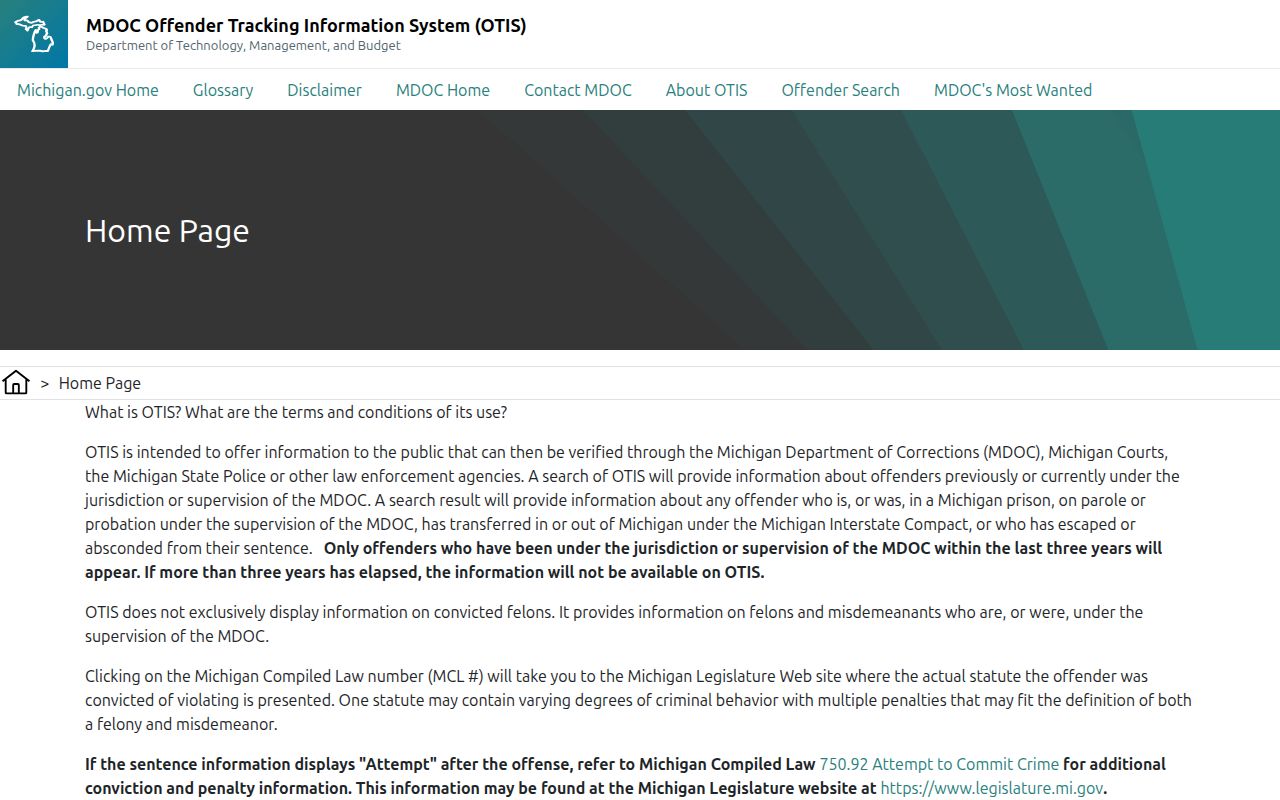
Use OTIS after a case reaches state custody or qualifying MDOC supervision, not as a replacement for current county jail confirmation. The broader Michigan parole and probation information describes how state supervision fits the criminal record chain.
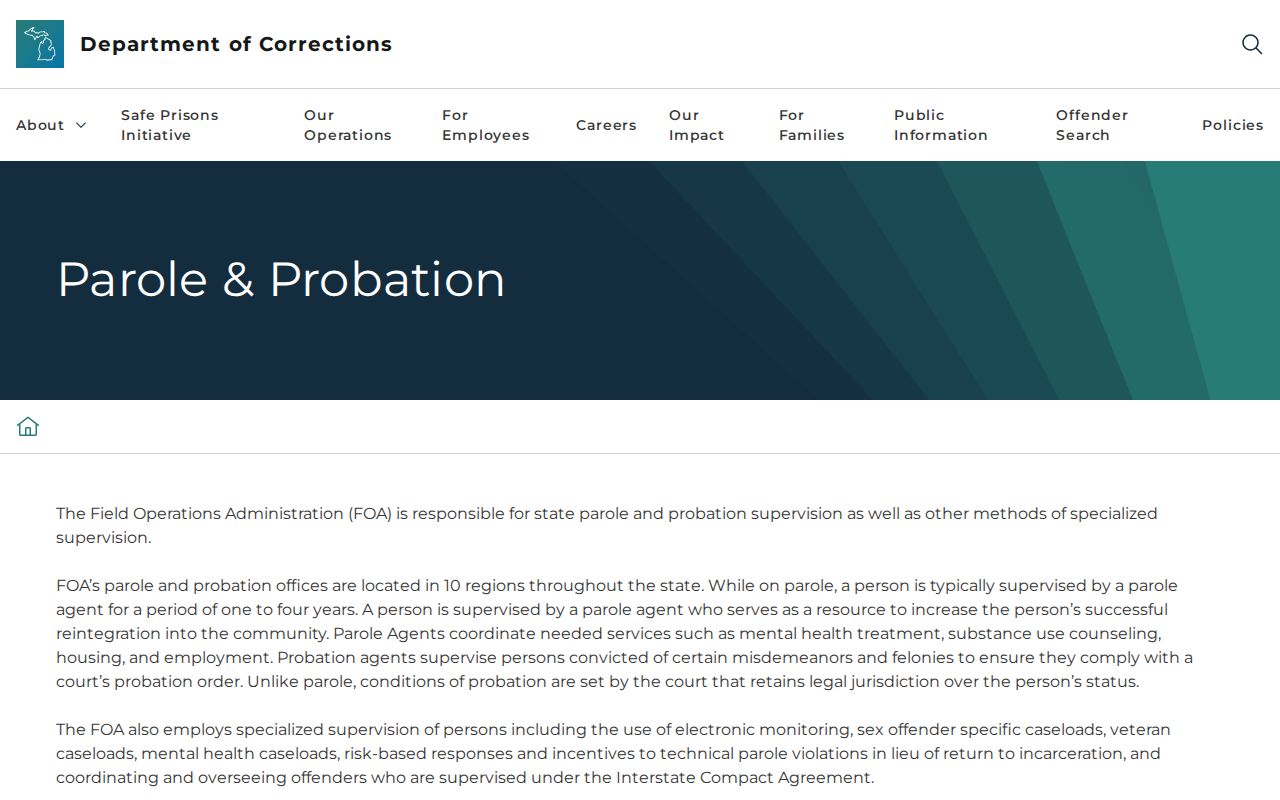
Together, the court record and MDOC source show different parts of a sentence, so a searcher should compare them instead of merging their status labels.
Four Tuscola County Criminal Record Systems
MiCOURT, ICHAT, OTIS, and the Michigan Public Sex Offender Registry answer four different questions. MiCOURT shows public Tuscola County court activity. ICHAT returns the public subset of reportable Michigan criminal history. OTIS locates people within its stated MDOC custody or supervision scope. PSOR publishes registry information for people and categories that Michigan law makes public. A searcher cannot use a blank result from one system to rule out a record held by another.
PSOR supports name, registration-number, MDOC-number, county, city, ZIP, address, and neighborhood-radius searches. Its public profiles may show a photograph, aliases, offense data, address, vehicle, registration details, and compliance status, but never victim information. High traffic can also make the registry briefly unavailable. Search again later instead of inferring that no registration exists. The full Tuscola County sex offender search explains the tier schedules, map fields, alerts, and lawful-use limits.
Use the systems side by side only when the question calls for it. A court dismissal, an MDOC discharge, and a registry status each has its own legal meaning. None should be treated as a substitute for the filed court order or as proof of a new offense.
Tuscola County Criminal Records by City
Caro, Vassar, and Cass City are the three largest incorporated places in Tuscola County by the official July 2025 estimates. Each police department keeps the incident records it creates, but none has a separate municipal court. Resulting prosecutions go to 71B District Court and, for a felony after bindover, 54th Circuit Court. The cards below lead to the exact local report channel and shared county court route for each community.
Caro Criminal Records
Population estimate 4,258. City police reports stay with Caro, while jail and court records follow the Tuscola County chain.
Vassar Criminal Records
Population estimate 2,685. Vassar Police is the report custodian, and county courts hold the filed prosecution.
Cass City Criminal Records
Population estimate 2,487. Village police records remain local, with court cases routed through 71B and 54th.