
Tuscola County Criminal Court Cases
Tuscola County uses Michigan trial courts, not city municipal courts. The 71B District Court tries misdemeanors punishable by no more than one year and handles traffic matters. It is also the first court for a felony. The complaint, arraignment, probable-cause conference, and preliminary examination occur there. If the judge finds enough cause, or the examination is waived, the felony is bound over to the 54th Circuit Court.
The 54th Circuit Court receives the felony after bindover. Its file can contain the information, later arraignment, motions, plea or trial events, sentence, and postjudgment work. The Probate and Family Division handles juvenile matters under special access limits. All three court contacts use the Tuscola County Courthouse at 440 N. State Street in Caro, but their case roles are not interchangeable.
The official court pages show how those duties split. The source image from the 54th Circuit Court captures the felony court’s public entry point.
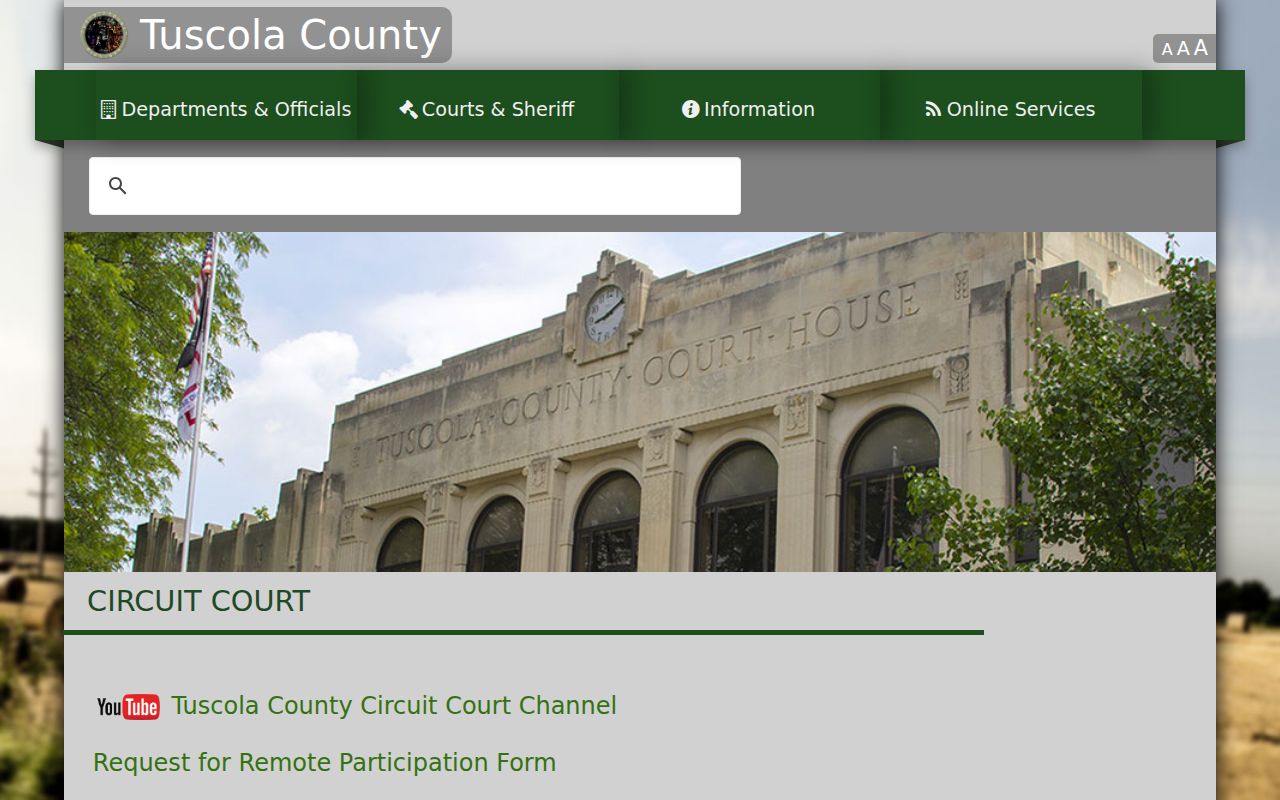
That court becomes the key clerk channel only after a felony reaches the Circuit Court stage.
Tuscola Felonies Take Two Courts
A common mistake is searching only one Tuscola County criminal court docket. A felony starts in District Court, so an early search may show only a 71B case. After bindover, the Circuit Court creates its own part of the record. A reader following the full prosecution may need both case references. The District Court file explains the start. The Circuit Court file explains the final felony outcome.
Case route: Charges Filed › Arraignment › Pretrial › Plea or Trial › Disposition › Sentencing
In Michigan terms, a preliminary examination tests whether probable cause supports moving the felony forward. Bindover is the transfer to Circuit Court. It is not a conviction. Misdemeanors generally remain with 71B through disposition and sentence, so no second trial-court file is expected for those cases.
Searching Tuscola County Case Records
MiCOURT Case Search is the free statewide starting point. Both Tuscola courts participate. The direct D71B route is useful when the matter is a misdemeanor or an early felony. Use the C54 court selection for a bound-over felony. Online data is informational and does not replace the official file. Some participating courts also apply a seven-year criminal-sentence display filter. A blank result is not proof that no case exists.
- Choose 71B District Court or 54th Circuit Court based on the case stage.
- Select a name or case-number search and enter the legal spelling.
- Add a middle name, birth date, filing year, or case type when the interface offers it.
- Open the result and note the case number, court, status, charges, and register entries.
- Ask the proper clerk for the register of actions or selected filed documents when the online view is not enough.
| Field | Control | Required | Use |
|---|---|---|---|
| Court | Selector | Yes | Choose D71B or C54 |
| Search Type | Choice | Yes | Name or case number |
| Last or Business Name | Text | For name search | Use the legal spelling |
| First and Middle Name | Text | First generally used | Helps separate similar names |
| Date of Birth | Date or text | Optional | Availability can vary |
| Case Number | Text | For number search | Use the displayed format |
| Year or Date Range | Filter | Optional | Narrows a long result list |
The direct 71B MiCOURT page shows the actual local search interface.
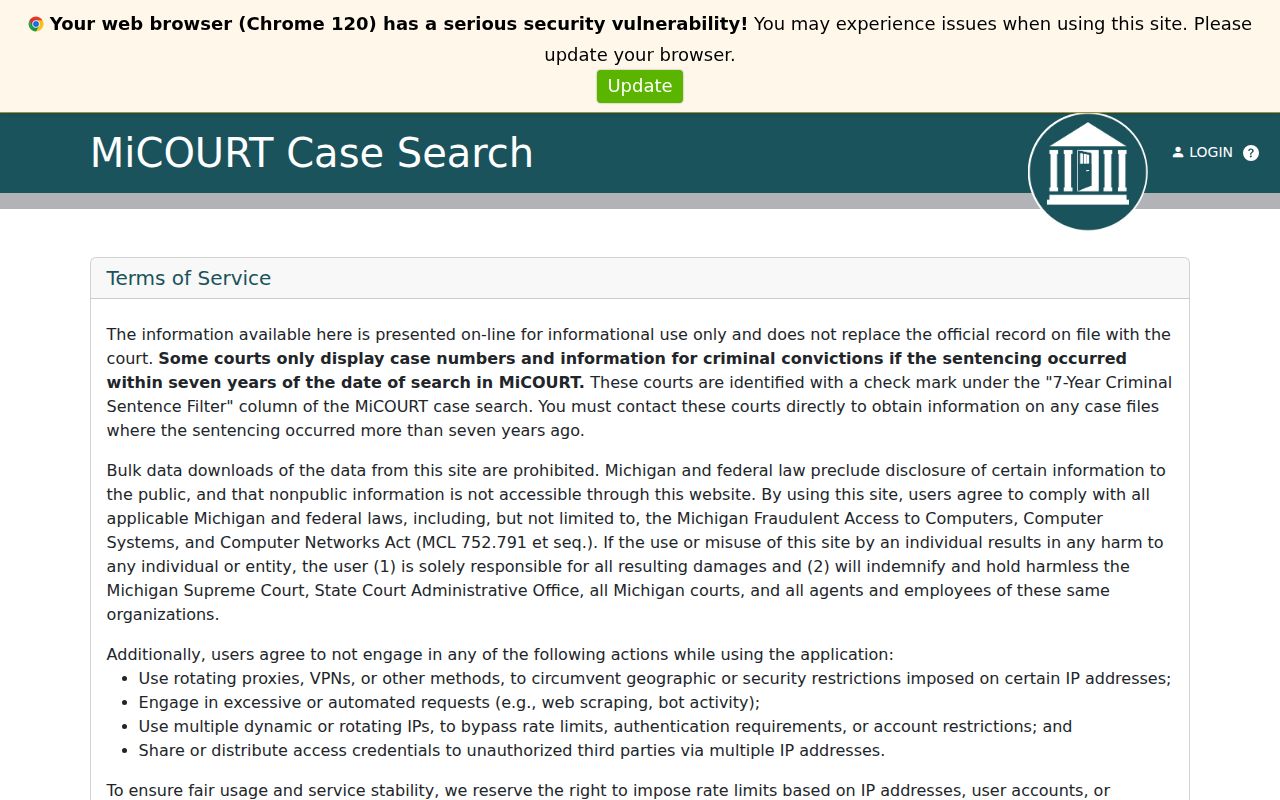
Its court-specific route removes one selection step but does not expand what Michigan law allows online.
MiCOURT Is Not Tuscola’s File
MiCOURT can supply fast identifiers. The Tuscola clerk remains the custodian of the official filed record. The online view may show court, case number, filing date, status, judge, parties, charge counts, hearing events, disposition, sentence terms, and public financial entries. It may not supply the complaint, information, motion, order, or exhibit as a downloadable document.
Order the register of actions first when the needed document is unclear. This dated list shows what entered the file. It helps a requester identify the exact complaint, information, plea record, judgment, or signed order. The approach saves money because the clerk’s copy fee depends on page count. It also avoids asking for the entire Tuscola County criminal case file when one order answers the question.
Inside a Tuscola County Case File
The court file tracks adjudication, not the full police investigation. A complaint is the first sworn charging paper. After felony bindover, an information states the Circuit Court charges. The register of actions then gives the event chronology. Each count must be read on its own because one count can end in conviction while another is dismissed.
| Case Number and Court | Identifies the file and whether 71B or 54th holds it. |
|---|---|
| Charging Document | Shows the prosecutor-authorized allegations, which may differ from booking labels. |
| Register Entries | Lists filings, hearings, orders, adjournments, warrants, and other public events. |
| Parties and Counsel | Shows public party roles and attorneys while restricted identifiers remain hidden. |
| Disposition by Count | Records conviction, dismissal, acquittal, or another result for each charge. |
| Sentence and Orders | Shows the court-ordered result and any public postjudgment action. |
The Tuscola County Clerk page is the official route for Circuit Court files and request forms.
The clerk can distinguish an ordinary copy from a true or certified signed order.
Tuscola Court Copies and Searches
If the case number is unknown, the clerk’s search form asks for the name, approximate years, and whether the request concerns criminal, civil, or both file types. A search from 1989 to the present costs $5 per name. Each year before 1989 adds $1 per name. The form calls for payment by money order to Tuscola County Clerk and a return route such as a stamped envelope or email.
When the case number is known, go straight to the copy request. An ordinary document, true copy of a signed order, or register of actions costs $1 per page. A certified signed order costs $10 for the first page and $1 for each added page. Certification is clerk authentication. It is useful when an institution requires official proof, while an ordinary copy is often enough for personal review.
| Request | Official amount | Best use |
|---|---|---|
| Name search, 1989-present | $5 per name | Find an unknown case number |
| Each pre-1989 year | $1 more per name | Narrow archived research |
| Ordinary or true copy | $1 per page | Read a selected filing |
| Certified signed order | $10 first page, then $1 | Obtain authenticated proof |
How a Criminal Case Moves
An arrest or summons can lead to a District Court arraignment, where the charge is stated and bond issues are addressed. A felony then moves through a probable-cause conference and preliminary examination or waiver. Bindover sends it to Circuit Court for an information, arraignment, motions, plea talks, plea or trial, and sentence. A presentence investigation may occur before sentencing. Appeals and later motions can add entries after judgment.
The charge language can change across that path. An officer’s booking label is not the prosecutor’s final complaint. The information may differ again after bindover. A plea can resolve fewer counts than the original filing. For that reason, the disposition and signed judgment answer the outcome question better than the first docket entry. The separate Tuscola County arrest lookup explains the earlier agency and jail records without treating them as court findings.
Tuscola Case Terms in Context
Michigan court language is compact. These terms mark distinct steps in a Tuscola County criminal court case and should not be treated as synonyms.
- Arraignment
- The appearance where the charge is stated and plea or bond matters are addressed.
- Bindover
- The transfer of a felony from 71B District Court to 54th Circuit Court.
- Information
- The prosecutor’s formal Circuit Court charging document after bindover or waiver.
- Disposition
- The result of one charge, such as conviction, dismissal, or acquittal.
- Register of actions
- The clerk’s dated list of filings and court events.
A dismissal ends a charge without a conviction on that count. It does not by itself erase the arrest, booking, or repository cycle. Michigan set-aside and correction law controls whether another record becomes nonpublic or is amended.
Case Record Access & Restrictions
Michigan Court Rule 8.119 governs public access to court records. Adult Tuscola County criminal court files are generally open unless a law, court rule, or order makes material nonpublic. Juvenile cases follow special limits. Sealed, suppressed, and set-aside matters may not appear in an ordinary search. Courts also protect Social Security numbers, full account numbers, victim and minor information, and other restricted data.
FOIA is not the main route for a judge’s adjudicative file. Use MiCOURT and the court clerk instead. When a public result is missing, check both Tuscola courts, try the case number, narrow or broaden the filing year, and call the proper clerk. Ask whether the file is older, in another division, or restricted. The 71B District Court number is 989-672-3800. The 54th Circuit Court number is 989-672-3720.
When Tuscola Cases Are Missing
No MiCOURT result can mean several things. The spelling may differ, the filing may be new, the case may have moved from 71B to 54th, or a display filter may apply. It can also involve a juvenile, sealed, suppressed, or otherwise nonpublic record. Search both court routes before drawing a conclusion.
The official District Court page provides the local contact behind the early felony and misdemeanor docket.
Clerk confirmation is the sound fallback when an online index cannot answer whether a public file exists.