
Checking Criminal History in Caro
Begin with the kind of Caro record you need. An incident narrative belongs to the Caro Police Department. A current custody question belongs to the Tuscola County Sheriff and Jail. Filed charges and outcomes belong to the 71B District Court or 54th Circuit Court. ICHAT, run by the Michigan State Police Criminal Justice Information Center, gives a public statewide summary of reportable Michigan events, but it does not replace any of those source files.
- Identify whether Caro Police, the sheriff, or another agency handled the event.
- Ask the creating agency for its report, using its FOIA route when needed.
- Search 71B District and 54th Circuit results through MiCOURT.
- Call the Tuscola County Jail when the question is current booking or custody.
- Use ICHAT for the public Michigan repository view, then verify it against the original office.
No result in one source ends the inquiry. A new Caro arrest may not yet have a court case, and a local misdemeanor may fall outside the public ICHAT product. Search names carefully and retain a case, incident, or booking number once one appears.
Caro County Seat, Split Records
Caro is the Tuscola County seat, so city police, the jail, prosecutor, clerk, District Court, and Circuit Court all operate in the same community. Their physical closeness can be misleading. Each counter keeps a different part of a Caro criminal record. The city does not take custody of the court file merely because the police made the first report, and the county jail does not become custodian of the police narrative when it accepts a person for booking.
- Police incident report
- Start with Caro Police or the City FOIA coordinator and identify the incident date, place, and report number.
- Booking or current custody
- Ask the Tuscola County Sheriff and Jail using the name, date of birth, and booking date.
- Filed charge and outcome
- Use the 71B District or 54th Circuit Court and provide the court case number when known.
- Public statewide history
- Use Michigan ICHAT with the required identity fields.
This split is the central Caro search rule. It also explains why two official answers may differ without either being wrong. They may describe separate stages or use different reporting cutoffs.
Caro Police Department Records
Caro Police operates from 317 S. State Street, Caro, MI 48723. The office line is 989-673-2402. Published office hours are Monday through Friday, 8 a.m. to noon, with other times by appointment, while patrol service continues around the clock. After-hours nonemergency calls go through Tuscola Central Dispatch at 989-673-8738, then option 1. The department handles investigations, arrests, traffic enforcement, emergency aid, school crossings, and its mandated records.
Caro Police Department
317 S. State Street
Caro, MI 48723
989-673-2402
Police records begin here when Caro officers created the report.
The city menu references an online reporting system. That is a way to submit certain reports, not a confirmed public search for an existing Caro police file. For a copy or inspection request, describe the event with enough detail for staff to locate it. Records can be redacted when a lawful exemption applies, and an open investigation may limit what can be released at that time.
Caro FOIA Record Request Fields
The Caro City Clerk serves as the city FOIA coordinator. Written requests may be delivered in person, by mail, email, or fax. The official Caro FOIA information page links the request form, public summary, procedures, cost form, discount affidavits, and appeal documents. A precise request helps the city find the intended police record without asking for a broad sweep of unrelated files.
The captured city form shows what a requester should prepare before filing.
| Requester details | Name, phone, address, email, and optional organization or fax |
|---|---|
| Requested product | Copy, certified copy, inspection, or subscription to a regularly issued record |
| Delivery choice | Pickup, onsite copying, mail, email, or city-supplied digital media |
| Record description | Incident, date, location, officer, or known report number |
| Completion | Signature, date, and optional consent to a longer response period |
The city may grant, partly grant, deny, or extend its response under Michigan FOIA. A response is not the same as immediate production when locating and reviewing the Caro record takes more time.
The official Caro FOIA page shown in the captured source helps readers confirm the current forms before sending a request.
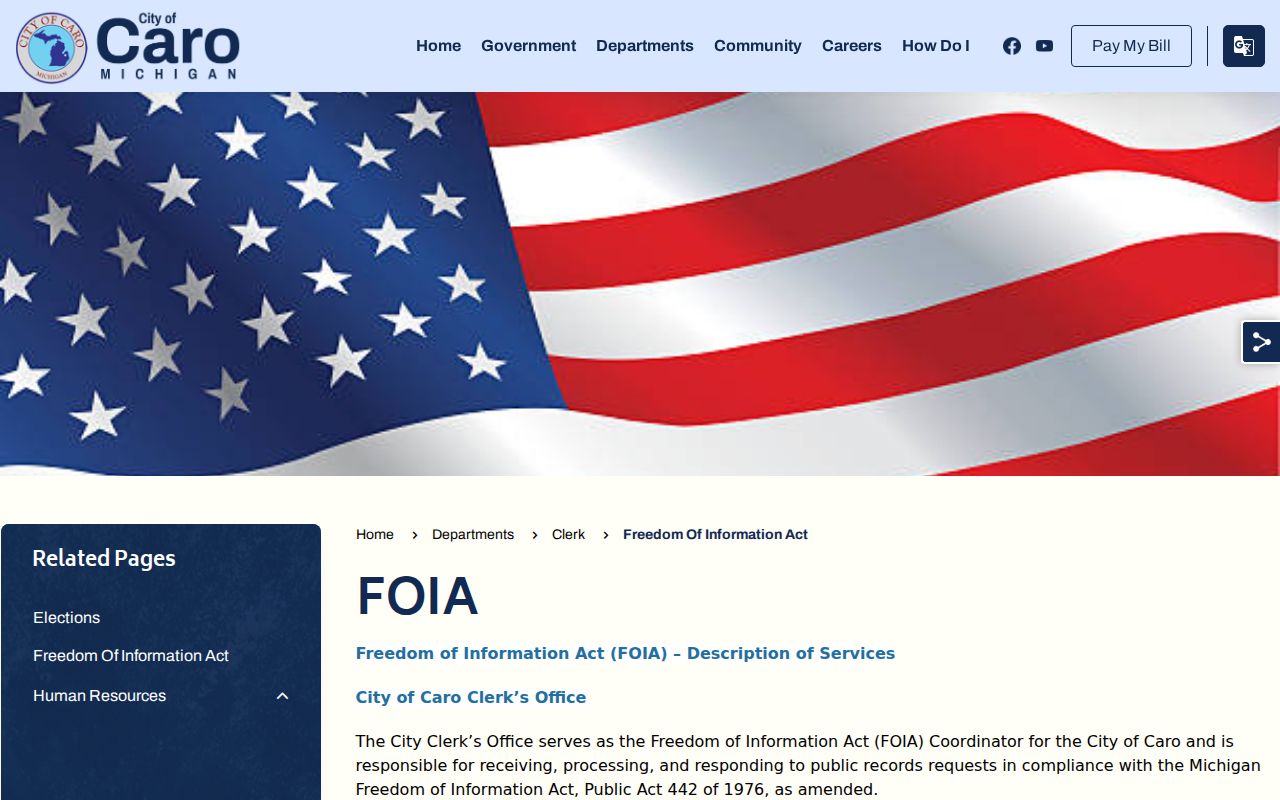
The captured page anchors the city-level request route and keeps police report access separate from court and jail channels.
Caro Arrests and Bookings
When Caro Police makes an arrest that requires county lodging, booking occurs at the Tuscola County Sheriff and Jail, 420 Court Street in Caro. Call 989-673-8161 for current custody or jail questions. No verified public Tuscola County inmate roster or arrest blotter was found, so a direct phone call is the fastest official check for recent custody. A formal request may be needed for a booking packet or releasable sheriff record.
The booking entry reflects intake facts such as the arresting agency, booking time, charge as booked, bond or hold, and release status. It does not settle guilt. The prosecutor may authorize different charges, and the court can later dismiss, amend, or resolve each count. For a deeper county-level explanation, the Tuscola County arrest lookup follows the full phone, FOIA, court, and state chain.
The official Tuscola County Sheriff page supplies the current county contact route. Use it to confirm jail and records procedures before requesting a Caro booking file.
Caro Police Report Versus Booking
A Caro police report and a county booking sheet answer different questions. The police report describes the reported event, the response, and investigative steps, subject to redaction. The jail record documents intake and custody. Neither one is the final court outcome.
- Incident report
- The Caro Police account created from the call, investigation, or enforcement action.
- Booking record
- The Tuscola Jail intake record made after a person enters county custody.
- Complaint
- The initial sworn charging document filed in court.
- Disposition
- The result of a charge, such as conviction, dismissal, acquittal, or another termination.
If the goal is to learn what a Caro officer recorded, ask the city. If the goal is current custody, call the jail. If the goal is the legal outcome, move to the court file. Using the right noun in a request often saves a second trip.
Municipal Court Records in Caro
Caro has no separate municipal court. Michigan routes local ordinance matters, misdemeanors, and the opening stage of felonies to the 71B District Court serving Tuscola County. A felony that is bound over moves to the 54th Circuit Court. Both courts are at 440 N. State Street in Caro, but they keep distinct dockets and perform different roles.
| Court name | 71B District Court, then 54th Circuit Court for a felony after bindover |
|---|---|
| Case types heard | District handles misdemeanors and felony preliminary stages; Circuit handles bound-over felonies |
| Case lookup channel | MiCOURT Case Search, followed by the appropriate clerk |
| What the docket shows | Case number, charges, events, status, hearings, dispositions, and public financial data |
| Copies and fees | Clerk forms govern name searches, ordinary copies, registers of actions, and certified orders |
MiCOURT is an informational view, not the official file itself. A missing online result can reflect restricted material, the court’s display rules, spelling, a recent filing, or a case held in the other Tuscola court.
Caro Records Through Two Courts
A Caro misdemeanor generally remains in 71B District Court. A felony starts there too, with complaint, arraignment, bond, a probable-cause conference, and a preliminary examination or waiver. If the judge finds the required basis or the examination is waived, the case is bound over to 54th Circuit Court. The prosecutor then files the Circuit Court information, and later pleas, trial events, sentence, and postjudgment filings appear in that file.
Case route: Caro Police report › 71B District Court › 54th Circuit Court after felony bindover.
A search limited to the Circuit Court can miss the earliest felony events. A search limited to District Court can miss the final outcome after transfer. Use the same name and known case number across both Caro court routes, then ask the clerk for the register of actions when the online chronology is unclear.
Caro MiCOURT Record Search
MiCOURT permits a name or case-number search for Tuscola’s participating courts. Name spelling matters. First and middle names, date of birth when available, and a filing-year filter can narrow common results. A case number is the most direct key. The display may show the court, judge, filed charges, offense dates, hearings, count-level dispositions, sentence entries, and the register-of-actions chronology.
| Search field | Use in a Caro search |
|---|---|
| Court | Select D71B or C54 based on the case stage |
| Search type | Choose name or case number |
| Name fields | Use the legal last and first name; add middle name when known |
| Date of birth | Use when the interface offers it to separate similar names |
| Case number or year | Narrow the record to the correct filing |
The official 54th Circuit MiCOURT interface in this source is the online starting point for a bound-over Caro felony.
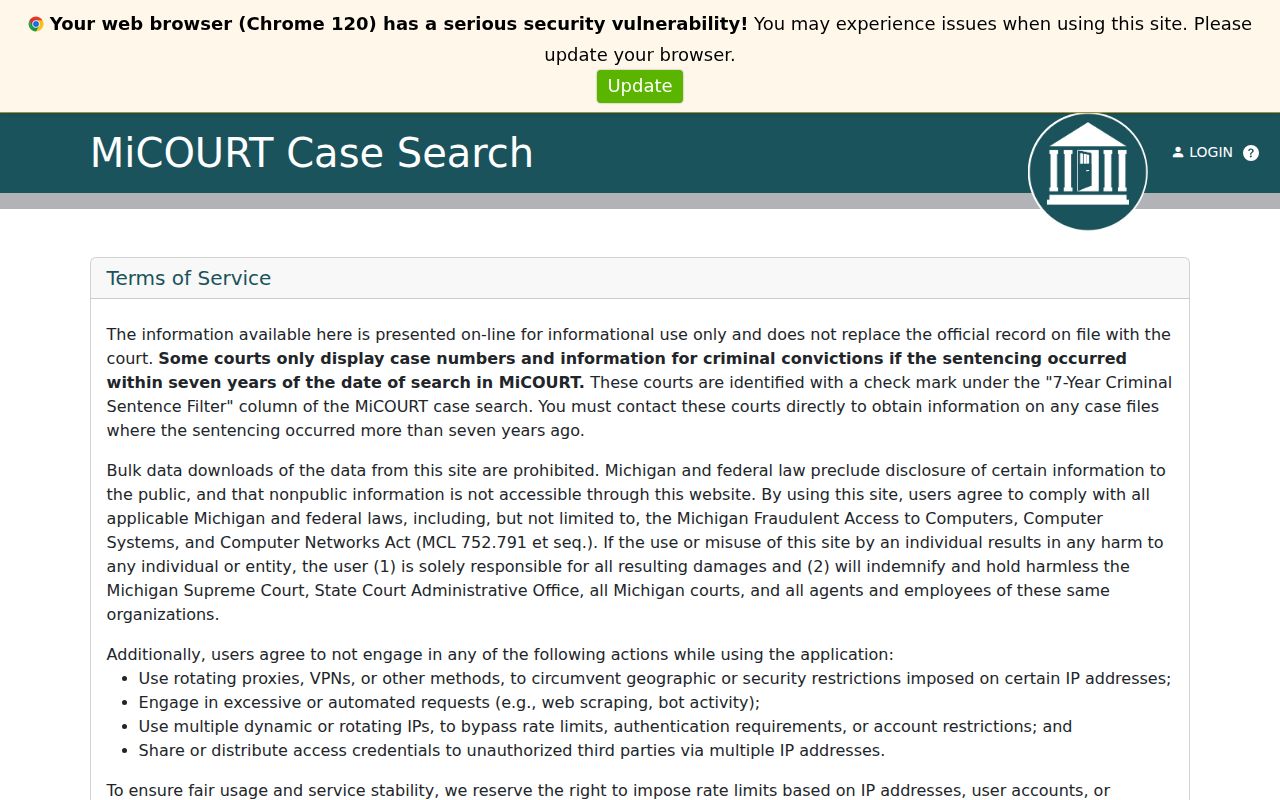
The court warning matters: online data does not replace the official Caro case file kept by the clerk.
Where Caro Records Go
A Caro event can produce several official records over time. Police create the incident file. Tuscola Jail creates a booking record if custody follows. The prosecutor decides what charge to authorize. The court records the filed case and disposition. For reportable offenses, identity, arrest, prosecutor, and disposition data can reach Michigan State Police CJIC and appear in the public ICHAT subset.
Record flow: Caro Police Department › Tuscola County Courts › Michigan State Police CJIC.
Timing and scope explain most gaps. ICHAT omits warrants, traffic matters, juvenile records, federal and out-of-state records, suppressed records, and local misdemeanors that are not reportable. It is broader than a Caro-only search across Michigan, yet narrower than the full set of city police and court files.
Caro Sheriff Activity Record Counts
Official 2024 MICR data for Caro Police lists 114 index offenses and 327 non-index offenses, for 441 reported offenses in all. The categories include 32 violent and 82 property offenses within the index group. These figures count reported offenses. They do not count defendants, arrests, court cases, or convictions, and they should never be used to infer facts about a person.
The sheriff’s separate locality table assigns 636 incidents or calls to Caro. That number is not the Caro Police crime total. Sheriff activity can include service calls and other work that does not become an arrest or a criminal case. Keeping the two datasets apart prevents double counting and preserves what each Caro record actually measures.
Public Access Rules in Caro
Michigan FOIA governs requests for Caro city agency records, including releasable police material. Courts follow Michigan Court Rule 8.119 and other court laws for case-file access. The city may redact or withhold material when disclosure would invade protected privacy, interfere with enforcement, reveal confidential sources or methods, endanger people, or expose other nonpublic information. It should separate nonexempt portions when reasonably possible.
Key Statutes:
MCL 15.231 states Michigan’s policy favoring access to nonexempt public-body records.
MCL 15.235 sets the usual five-business-day response framework and permitted extension notice.
MCL 15.243 lists privacy and law-enforcement exemptions that can limit a Caro police release.
MCL 28.243 controls dissemination through Michigan’s criminal-history system.
Juvenile, victim-sensitive, sealed, and set-aside material follows added limits. Public access is a right to eligible records, not permission to harass, threaten, misuse an identity, or ignore the final court outcome.